
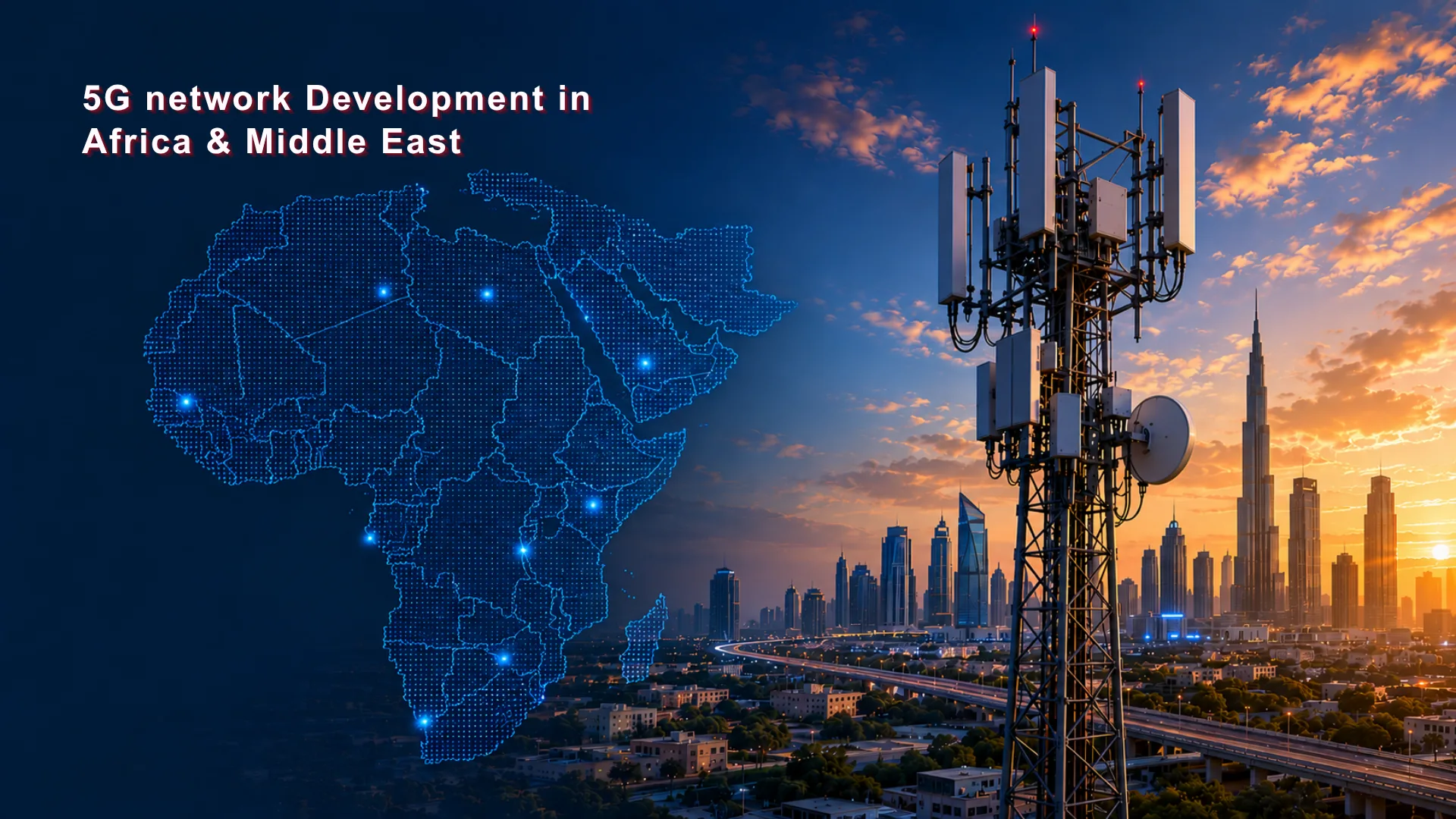
In 2026, 5G network deployment across Africa and the Middle East has shifted from aspiration to operational reality. Towers are live. Spectrum is allocated. Enterprise clients are signing contracts. But the telecom operators and infrastructure partners who will define the next decade of digital growth in these regions are not simply those with the largest capital budgetsthey are those who can execute 5G network deployment faster, more reliably, and at greater scale than anyone else in the market.
For telecom operators, carriers, and OEMs competing across Africa and the Middle East, speed-to-market is not a KPI on a dashboard. It is the difference between market leadership and years of expensive catch-up.
The Scale of 5G Network Deployment Across Africa & the Middle East
The numbers define the urgency. Across the MEA region, 5G network deployment in Africa is accelerating across Kenya, Nigeria, South Africa, Tanzania, and North Africa simultaneously. Morocco activated its national 5G network in November 2025, with all three major telecom operators going live on the same day, with regulators mandating 45% population coverage by end-2026 and 85% by 2030, backed by an $8 billion national investment commitment.
5G network deployment in the Middle East is even more mature. By end-2026, 5G is forecast to account for 73% of all mobile subscriptions across GCC countries. Saudi Arabia, the UAE, and Qatar are global benchmarks. Second-tier markets, Oman, Kuwait, Iraq, and Jordan, are now entering aggressive network expansion phases of their own.
The MEA telecom market is projected to reach $381.79 billion in 2026, growing to $633.38 billion by 2031. Every dollar of that growth depends on 5G network deployment happening on schedule, at quality, and at scale. Miss a coverage milestone and the cost is not just regulatory it is market share that competitors will not give back.
What Makes 5G Network Rollout in Emerging Markets So Difficult
The barriers to fast 5G network deployment in Africa and the Middle East are not the same challenges faced in Western markets. They are harder, more unpredictable, and require a fundamentally different execution model.
Energy and power infrastructure
Grid instability across sub-Saharan Africa means that network uptime depends directly on integrated energy solutions, solar hybrid systems, battery backup, and off-grid power management. Without reliable power, a deployed 5G tower is not an asset. It is a liability that damages the operator’s reputation and burns the maintenance budget.
Terrain and adaptive site engineering
From Ethiopia’s highlands to the Arabian desert, every 5G tower deployment in emerging markets requires site-specific engineering. Cookie-cutter approaches from mature markets fail on contact with real African and Middle Eastern terrain.
Multi-country regulatory complexity
Spectrum licensing, permitting, and environmental compliance frameworks differ not just by country but by sub-national region. Telecom infrastructure services in Africa demand teams with deep local regulatory knowledge, not just global engineering credentials.
Workforce depth and deployment readiness
Fast 5G network deployment requires a skilled, immediately deployable workforce, not a six-month recruitment pipeline. Managed services partners who arrive with pre-built, trained teams eliminate the execution lag that kills delivery timelines.

How Innovis Powers 5G Network Deployment Across Africa and the Middle East
Innovis operates one of the largest independent telecom infrastructure services footprints on the African continent, with active operations across Kenya, Uganda, Rwanda, Ethiopia, Tanzania, Zambia, Madagascar, and key Middle East markets. Backed by 2,000+ professionals across 20 countries and 15+ years of in-region execution, Innovis manages the complete network lifecycle: planning, 5G network deployment, network rollout and modernisation, managed services and operations, network performance management, and consulting.
Their energy solutions portfolio, solar hybrid, off-grid power, and battery systems ensure every deployed tower sustains the network uptime telecom operators need to meet coverage milestones. Their fibre deployment capabilities connect the enterprise corridors that anchor 5G’s commercial value proposition.
Operators partner with Innovis not just to deploy faster but to deploy right the first time, eliminating costly rework, avoiding regulatory penalties, and converting infrastructure investment into revenue at pace.
About Innovis
Innovis is a global leader in 5G network deployment across Africa and the Middle East, delivering end-to-end network rollout, managed services, energy solutions, and network modernisation across 20 countries. Learn moreabout innovis.in
5G Network Deployment Is Now a National Economic Strategy
In 2026, 5G network deployment across Africa and the Middle East is no longer just a telecom infrastructure story. Private 5G networks are enabling Industry 4.0 manufacturing in Africa. Fixed wireless access (FWA) in Africa is closing the rural digital divide where fibre economics don’t reach. IoT and smart city programs across the Gulf are creating enterprise demand pipelines that will sustain investment across the next decade.
For any carrier, telecom operator, OEM, or tower company, the strategic question in 2026 is simple: who will deliver your 5G network deployment at the pace, quality, and compliance standard the market demands without the execution failures that come from deploying without the right on-ground partner?
Speed-to-market is everything. And the infrastructure partner you choose will determine whether you lead this market or spend the next five years watching someone else do it.


